Why is My Dodge Motor Ticking?
If you own a Dodge with a 5.7L Hemi V8, you've probably heard it — or heard about it. The tick. Forums call it the "Hemi tick." Dealers have called it normal. Friends have called it a quirk of the engine. And for years, Dodge owners have been told to just live with it.
Here's the problem with that: sometimes it's not the Hemi tick. Sometimes it's your engine telling you it's failing from the inside — and by the time you stop ignoring it, the damage is already done.
At Chuck's Garage in Killeen, TX, our ASE-certified technicians have seen this play out firsthand. A customer brought in their Dodge with a ticking noise they'd been brushing off. This time, there was also a fuel smell — which had started about a week before. That combination sent up a red flag immediately. What followed was a deep diagnostic process that revealed a worst-case scenario hiding behind what most people write off as normal Dodge behavior.
This post breaks down exactly what we found, why the Hemi tick isn't always benign, and what you should do if you're hearing that noise right now.
What Is the "Hemi Tick" — and Why Do People Ignore It?
The 5.7L Hemi V8 has a documented history of producing a ticking or tapping sound — particularly during cold starts or at idle. Stellantis (formerly FCA) has even acknowledged a specific version of this noise in NHTSA Technical Service Bulletin 09-019-23, which covers a cold-start ticking caused by cracked exhaust manifolds on 2019–2022 Dodge Durango and Ram 1500 models with the 5.7L Hemi. That TSB is real, the repair is real, and the noise is real.
But here's where things get dangerous for Dodge owners: because some ticking on these engines is documented and known, people assume *all* ticking is acceptable. That assumption has cost owners engines — and in some cases, led to complete engine replacements that could have been avoided with earlier intervention.
The Two Types of Hemi Tick You Need to Distinguish
Type 1 — Exhaust Manifold Tick:
This is the one Stellantis officially acknowledges. It's caused by cracked exhaust manifolds and is most noticeable during cold starts. It typically diminishes once the engine warms up. It sounds like a surface-level tapping. This is a legitimate repair, but it is not catastrophic if addressed promptly.
Type 2 — Internal Valvetrain / Engine Tick:
This is the one that should concern you. When the tick is coming from inside the engine — from the valvetrain, camshaft, or cylinder head area — it is not a quirk. It is a symptom of mechanical failure. Oil starvation, worn cam lobes, pitted camshafts, and failing MDS lifters are all internal failures that produce a ticking or rattling sound. This type of tick does not go away. It gets worse. And it will eventually leave you stranded or facing a complete engine replacement.
The difference matters enormously. Confusing one for the other — or assuming it's benign — is exactly how a fixable problem becomes a catastrophic one.
What We Found: A Real Case From Chuck's Garage
⚠️ Customer Complaint
"Customer states there is a ticking noise and it smells like fuel. Customer notes the fuel smell started about 1 week ago."
That combination — engine tick plus fuel odor — is not a normal Hemi tick scenario. Fuel smell can indicate a vacuum leak, a failing fuel pressure component, or issues tied to the engine's MDS (Multi-Displacement System) vacuum pump. Our technicians knew this needed a thorough diagnostic, not a quick listen and a shrug.
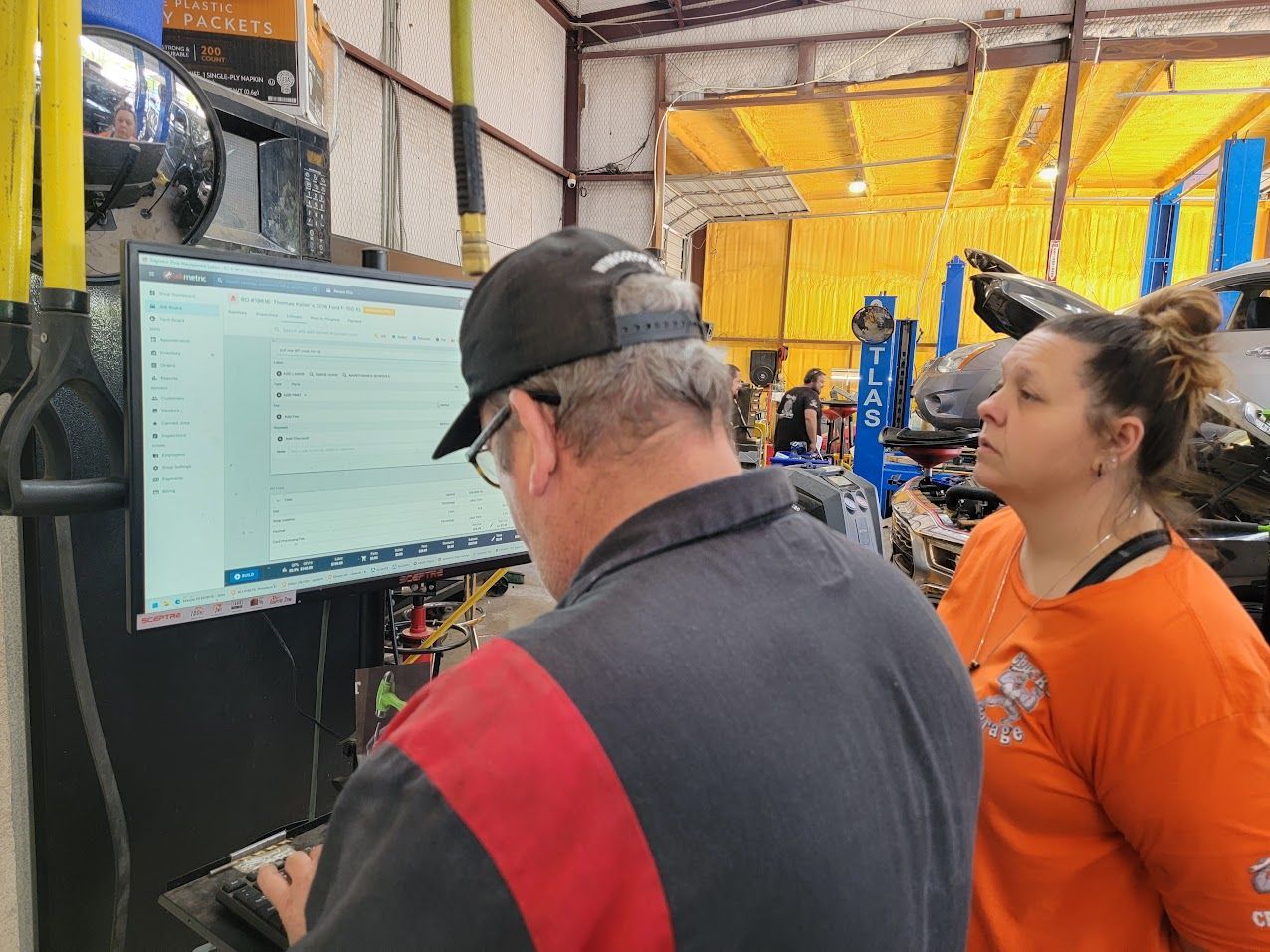
Initial Diagnosis — RO #18896
When our tech put the vehicle on the lift and began inspection, the findings were clear:
"Inspected customer concern for vehicle engine ticking noise. Inspected oil condition — ok at this time. Inspected data for any codes indicating a failure — no obvious issues found at this time. Vehicle engine has an internal rattle indicating internal failure. Recommend replace or tear down all of engine for inspection. See attached pics and videos."
Oil was clean. No fault codes pointing to a specific component failure. But the rattle was unmistakably internal — not surface, not exhaust, not accessory-driven. The engine was failing from the inside. With that finding, engine replacement was recommended and approved.
Engine Replacement — And What Came After
After the replacement engine was installed, our technician ran a full post-install inspection. That's where the next flag appeared:
"Upon completion of engine replacement, found P258B — vacuum pump performance. Recommend replace pump and retest."
P258B is a code tied to the vacuum pump that supports the brake booster on 5.7L Hemi-equipped vehicles. On these engines, the vacuum pump is mechanically driven off the camshaft. When it's underperforming, it can be a sign of timing or cam-related issues — or a standalone pump failure. Either way, it doesn't get ignored.
This also helps explain the fuel smell the customer reported. Vacuum system issues on the Hemi can affect fuel trim, idle quality, and the behavior of the MDS system — all of which can contribute to a noticeable fuel odor in or around the vehicle.
The Warranty Block: When the Replacement Engine Raised Its Own Red Flags
After the engine swap, a warranty claim came into question when cylinder 6 showed a low compression reading. LKQ (the parts supplier) required documentation before honoring the claim. Our technicians ran the full protocol:
"Testing for warranty claim. Video of engine running with the belt off while making noise. Pictures of cylinder #6 low compression reading. Pictures of healthy cylinder compression readings. Video of leak down test with commentary of where the leak is. As requested, pictures and videos of results uploaded."
Here are the actual compression numbers:
- Cylinder 2: 205 psi ✅
- Cylinder 4: 200 psi ✅
- Cylinder 6: **150 psi** ⚠️
- Cylinder 8: 200 psi ✅
A healthy cylinder on a 5.7L Hemi should read between 180–210 psi. Cylinder 6 came in at 150 — a 25–30% drop from the healthy cylinders. That's not a borderline reading. That's a definitive failure.
The leak down test confirmed where the compression was going:
"Cylinder leak down test results show leak coming from exhaust valve. Exhaust pressure is felt and noted when engine is at TDC all valves closed."
A leaking exhaust valve at TDC with all valves closed means the valve seat is not sealing. That's a mechanical failure inside the cylinder head — not a gasket issue, not a ring issue, not something that fixes itself.
Cylinder Head Removal: The Final Finding
With the data in hand, the right cylinder head was pulled for inspection. What the borescope revealed sealed the diagnosis:
"Removed cylinder head for inspection. Johan inspected the camshaft with borescope for diagnosis. Found pitted. Recommend a new engine."
Pitting on the camshaft is the result of oil starvation, metal-to-metal wear, or breakdown of the cam lobe surface itself. Once a camshaft lobe is pitted, it accelerates wear on the lifters, rocker arms, and valvetrain components it contacts. The low compression in cylinder 6, the exhaust valve leak, the internal rattle — it all traces back to a compromised camshaft that had been working against the engine for some time before it was ever addressed.
This is the Hemi tick people dismiss as "normal." This is what it can become.
Pros and Cons of Ignoring an Engine Ticking Noise on Your Dodge
Pros of Getting It Inspected Immediately
- You catch it before it escalates. A worn lifter or early cam lobe damage can sometimes be addressed without a full engine replacement — but only if caught early enough.
- You have documentation. Compression tests, leak down data, and diagnostic codes create a paper trail that supports warranty claims and gives you leverage with parts suppliers.
- You protect your investment. Whether your Dodge is a daily driver, a work truck, or a Fort Cavazos commuter vehicle, an unexpected engine failure is never a cheap problem.
- You avoid secondary failures. As this case shows, vacuum pump codes (P258B) and fuel odors can follow unresolved engine issues. Catching the root cause stops the chain reaction.
- You get honest answers. An ASE-certified mechanic will tell you what's actually wrong — not what's easiest to say.
Cons of Waiting or Dismissing the Noise
- Internal damage compounds quickly. A pitted cam lobe does not stop pitting. Every hour the engine runs, it does more damage to adjacent components.
- Warranty windows close. Whether it's a new vehicle powertrain warranty or a parts warranty on a replacement engine, those windows are time- and mileage-limited. Waiting burns them.
- Diagnostic costs increase. The further internal damage progresses, the more labor it takes to trace and document the failure. What costs an hour of diagnostic time today may cost five or nine hours after the damage spreads.
- You may end up at a "second engine" situation. This case involved two engine evaluations. That's not rare when a problem is allowed to develop unchecked.
- A fuel smell is never something to dismiss. Fuel odor combined with engine noise is not a coincidence. It's a signal that multiple systems are being affected.
Why Killeen Drivers Trust Chuck's Garage for Engine Diagnostics
When a noise could mean anything from an exhaust manifold gasket to a destroyed camshaft, you need a shop that doesn't guess — and doesn't tell you what you want to hear. Chuck's Garage has been the trusted repair shop for Killeen drivers since 2010, and our ASE-certified technicians have the tools and experience to tell the difference between surface noise and internal engine failure.
We document everything. Compression numbers. Leak down percentages. Borescope footage. That documentation matters — whether you're filing a warranty claim, making a repair decision, or just need to know what you're dealing with. We've navigated LKQ warranty processes, P258B codes, cylinder head inspections, and engine replacements, and we know how to build the case for you when the parts supplier needs proof.
We also know this community. Killeen, Harker Heights, the Fort Cavazos area — these are working families and service members who can't afford to have their vehicle sitting in a shop for weeks because someone misdiagnosed a tick. We move with urgency because we know your time matters.
On top of that, we offer financing through Affirm, Snap Finance, Synchrony, and Klarna — because an engine diagnosis or replacement shouldn't have to wait because of cash flow. And if your vehicle can't make it to us, Bill's Towing has you covered with free towing integration directly to our shop from in town.
If your Dodge is ticking, don't write it off as the Hemi tick until a real mechanic has looked at it. Schedule your engine diagnostic at Chuck's Garage today, or check out the other makes and models we service to confirm we work on your vehicle.
If you are considering purchasing a new vehicle please allow us to perform a Pre-Purchase Inspection so you can buy with confidence
That tick deserves a second opinion — not a shrug. Chuck's Garage is Killeen's ASE-certified auto repair shop, and we're ready to give you the straight answer on what's going on inside your engine. Call us today at or stop by. Don't let a noise become a catastrophe.